


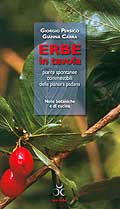
Erbe in tavola
Edible spontaneous plants of the Po Plain - Botanical and cooking details
Besides the botanical, environmental, morphological, and historical relevance, "Erbe in tavola" promotes the easy identification of each plant by people who do not know them, while the appendix dedicated to the cuisine gives the opportunity to go from botany to taste.From the Sorrel to the common Nettle, from the Watercress to the Aquatic Mint, and again Rampion, Valerian, Black Mustard, Watercress, Old Man's Beard: there are 50 plants described and photographed (but more than two hundred varieties have been quoted) growing in the meadows, on the shores, on the stretches of water, and which with their presence tell the tale of the landscape of the Po Plain, where the Parks of Mincio and Oglio are situated.
Taken from the presentation:
"The world of plants has inspired symbols, legends, proverbs, poems, and customs giving life to a parallel universe, but at the same time it has been subject to a pregnant reality of food and medicine.
This world is therefore described in many ways.
To go over flowers, plants, trees from this point of view, as well as to understand how vegetables or legumes are cultivated or spontaneously grow, might be useful to revisit our history, our cultural background going from the ingenuous rural proverb to poetry, to the magical use, to the alimentary and medicinal function of herbs.
Parco del Mincio and Parco dell'Oglio Sud, with the support of the Province of Cremona and Consorzio Agrituristico Verdi Terre d'Acqua have decided to publish this guidebook which, with the "pretext" to remind ancient recipes, leads us to know unusual plants, which are nowadays marginal and often neglected, tells us about their ancient use by making them resurface from the depth of the culture of our plain, and warning us that some of them were once abundant, while today they are rare and protected by regional laws.
Protecting nature and giving back dignity and value to degraded areas, spreading the knowledge of the environments and of the ecosystems, of the vegetables and animals still existing is an institutional task and one of the main ones of Parks, which must do everything they can to reach this aim.
Also the publication of a book of old 'recipes', when they are presented with skill and scientific rigor, can be useful to improve the naturalistic knowledge".
- Author/s: Giorgio Persico - Gianna Carra
- Publisher: Tre Lune edizioni
Notes: Sold out
Erbe in tavola


© 2024 - Ente Parco del Mincio