Mammals
Besides the roe deer, which is without a doubt the
most representative animal of the Boschi di Carrega, among the most
important ungulates there is the wild boar, which is a steady presence
in the Park since ten years. The Park's theriofauna is
well-diversified, thanks to the high degree of maturity and complexity
of the forest environment. There are several species of micromammals,
among which shrews, voles, wood mice and dormice; squirrels and hares
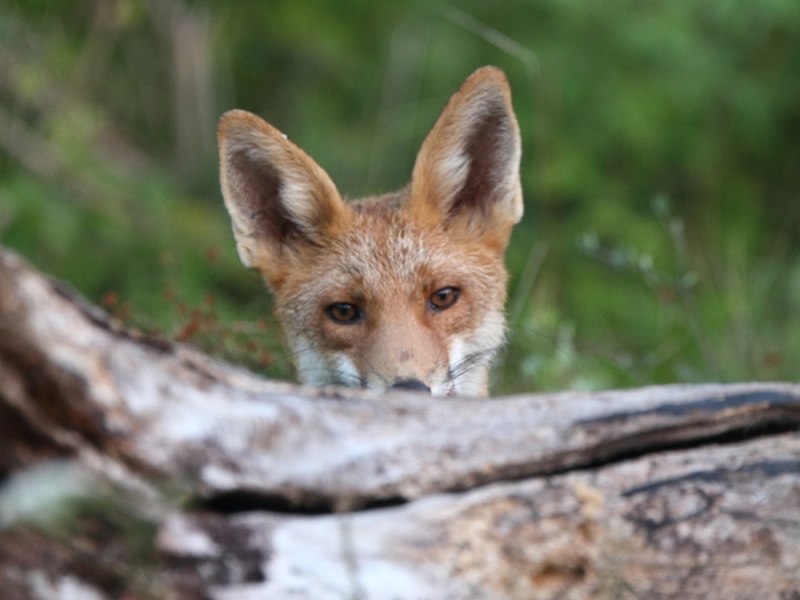
are also widespread. Carnivorous animals, whose presence is
demonstrated by the analysis of traces and excrements, are mainly
foxes, badgers, stone martens, and weasels.
Birds
The composition of the ornithofauna is
rather complex (about 70 species regularly present during the year) and
it provides an almost complete review of the species which are typical
of the environments extending from the plain to the middle Apennines.
The green woodpecker and the great spotted woodpecker can be sighted,
together with several tits (great tit, blue tit, marsh tit) and other
species, such as the tawny owl, the nuthatch, the short-toed
treecreeper, the redstart, the jay, the turtle dove, the blackcap, the
robin, the melodious warbler, the nightingale, and the whitethroat. In
the areas of transition between the wood and the cultivated fields and
in the clearings, if you are lucky, you might sight two predators, the
sparrowhawk and the hobby, which mainly eat small birds. Moreover, you
can easily observe the serin, the blackbird, the chaffinch, and the
greenfinch. There are also many aquatic birds, such as the night heron,
the little egret, the gray heron, and several species of ducks coming
from the nearby Taro Regional Park or passing during the migration periods.
Amphibians and Reptiles
The Park is also rich in herpetofauna: among the amphibians, the most
widespread species are the common toad, the European common frog, the
agile frog, and the common tree frog; in small lakes and puddles there
are several crested and smooth newts. Less frequent the green toad, a
species typical of the plain, and the yellow-bellied toad, which
usually lives in puddles and streams in clayey soils. There are also
specimens of fire salamander. Among the reptiles, of considerable
interest is the autochthonous presence of the European pond turtle
living in the lakes and in the pools, while the Hermann's tortoise has
been artificially introduced. The common wall lizard usually lives in
the woods, while the Italian wall lizard and the much more evident
green lizard prefer open and sunny places. In the clearings and at the
edges of the wood you can sometimes see the blindworm, a snake-like
Saurian. Among the Ophidia, the most frequent ones are the western whip
snake, the aesculapian snake, and the grass snake; less frequent the
dice snake, the asp viper, and two species of modest size
belonging to the Coronella genre: the smooth snake and the southern smooth snake.
The chestnut groves
About half of the more than a thousand
hectares of the Park are covered with woods which, above all in the
marginal areas, alternate with sowable lands and permanent meadows,
often bordered by wonderful hedges. Great part of the vegetation
coverage consists of chestnut groves introduced in the first decades of
the last century, when the chestnuts still were an important element of
the human diet. Among the trees which frequently grow together these
chestnut trees, there is the flowering ash tree, which is often
accompanied by the intrusive locust tree. In the shrubby stratum there
are mainly field alders, while the herbaceous stratum is dominated by
tufts of bracken fern.
Beeches and transitory species
On the hills, the
chestnut groves alternate with forests, partly autochthonous, partly of
anthropic origin, like the pinewood of Monte Tinto. From a botanical
point of view, the area lies between the plain belt and the oak woods
on the hills, but the many watercourses carving more or less deeply the
terraces on which the Park extends itself, have locally favored the
setting up of particular climatic conditions influencing the
vegetation. As a matter of fact, in the wet valleys there are the ideal
conditions also for species which are typical of much higher altitudes
than the local ones varying between the 120 and the 320m. A beautiful
example is the Beechwood of Maria Amalia, a unique wood at low
altitudes: the beech is a typical mountain species, covering the
reliefs until the limits of the arboreal vegetation.
The oak and conifer woods
The rest of the vegetation mainly consists of often impenetrable woods
of oaks and of formations where conifers grow together with broadleaved
trees.
In the oak woods, the Turkey oak and the sessile oak dominate; the
Downy oak prefers instead more sunny places and you can find it only in
mixed oak woods, where no species dominates over the others. Sometimes
the Scotch pine - which can be considered spontaneous - grows together
with the oaks, and together with the exotic black pine, spruce and
silver firs, introduced more than one century ago.
The mushrooms
The Park's micoflora is particularly varied and abundant; recent
researches have found out the presence of about 400 mushroom species
(except the microscopic ones). The alternation of meadows, sowable
lands, mixed woods of broadleaved trees and groups of conifers provides
a considerable variety of habitats which are favorable to the
development of different species. Late summer and autumn are the most
suitable seasons for the growth of fruit-bearing species; however,
already in spring the White Morel and the Common puffball grow.
Clusters of inkcaps and of Hipholoma cover the stumps of oaks or other broadleaved trees, while on the
chestnut trees there is the Beefsteak Fungus. The grassy lands house
the well-known Parasol Mushroom and other species of the same group,
together with the common meadow mushroom and several hygrophytes.
The hunting holding of the Farnese family
When at the half
of the 16th century the Farnese family became the owner of the dukedoms
of Parma and Piacenza, great part of the woods around Sala and
Collecchio belonged to the noble Sanvitale family, the local feudal
lords for about three centuries. In particular, the so-called "lands of
Sala", set between the stream Baganza and the wide surrounding woods,
were for centuries the target of the Farnese family, which was already
entitled to hunt in the nearby woods. In 1612, Ranuccio I Farnese,
after accusing them of conspiracy, put to death Gianfrancesco and
Girolamo Sanvitale and Barbara Sanseverino, so that he could attach to
his properties their residences in Sala and Colorno.
The Borbone family from Parma
In 1731, after the
death of Antonio Farnese, the dukedom passed to the Borbone family. In
the second half of the 18th century, Maria Amalia, daughter of Maria
Teresa from Austria and wife of Ferdinando di Borbone, entrusted the
architect Petitot to build the Casino dei Boschi on the hills
surrounding Sala. The building would be a summer residence and a
hunting lodge, and it was finished in 1789.
The period of Maria Luigia
The Napoleonic invasion marked the end of the government by the Borbone
family and later the Vienna congress assigned the dukedom of Parma to
Maria Luigia, Napoleon's wife and daughter of the Emperor Francesco I
from Austria. In 1819 Maria Luigia bought from the heirs of Maria
Amalia the Casino dei Boschi and the 60 hectare annexed estate. Between
1819 and 1826, the building was enlarged and renewed under the guide of
Nicola Bettoli. By order of Maria Luigia, Carlo Barvitius, a gardener
who had previously worked at the Habsburg court, began to carry out
works of transformation of the inner road network, of the water system,
and of forestation.
From the Carrega family to the Park
With the death of Maria Luigia, in 1847 the dukedom passed to Carlo III
of the Borbone family from Lucca and, with the Union of Italy, the
Savoia family became the owner of the estate of Sala and Collecchio, at
that time extending itself for 585 ha (550 of which were included in
the current Park's area); in 1865 the woods were declared "Royal
Hunting Reserve of the former Dukedom". The prince Andrea Carrega, fond
of botany and expert in sylviculture, prepared a collection with 555
specimens corresponding to the arboreal species present in the woods.
At the death of Andrea Carrega, the children alienated great part of
the properties, favoring the lotting of some areas and partially
altering the consistency of the wood landscape. At the beginning of the
70s, a consortium for the acquisition of the woods and the creation of
a public park was established among the local municipalities. The whole
complex of the Boschi di Carrega was subsequently transformed into
"public green area" by the municipality of Sala Baganza, creating the
premises for the subsequent establishment of a regional park.
The terraces of Taro and Baganza
The hills which, in a unique
succession of parallel ridges, separate the Taro from the Baganza near
the plain, are linked to the Quaternary history of the two
watercourses. The outcropping soils represent the river sediments
organized in terraces which formed during the last three glacial
periods (Mindel, Riss, and Würm, between 500,000 and 15,000 years ago).
These ancient alluvial deposits, among which there are also the aeolian
silts (the so-called loess) which are typical of the steppe extending
in this area in the glacial period, are an evidence of the results of
the great Quaternary climatic changes in the piedmont area and of the
alternation of very different environmental situations.
The red soils
During the warm periods between the glaciations, the alluvial deposits
deeply changed, subject as they were to intense pedogenesis phenomena
which led to the creation of mainly clayey soils, with a red-yellow
color due to the accumulation of iron oxide and hydroxide.
The gullies of Maiatico
The
reliefs rising at the southern edges of the Park are made of clayey
sediments coming from the sea, which deposited during the middle and
upper Pliocene on rather deep bottoms. The famous gullies of the Costa
near Maiatico witness how easily these rocks can be eroded: they can be
seen in many points of the hills in Emilia outcropping with these
typical morphologies.