Origins and Some History
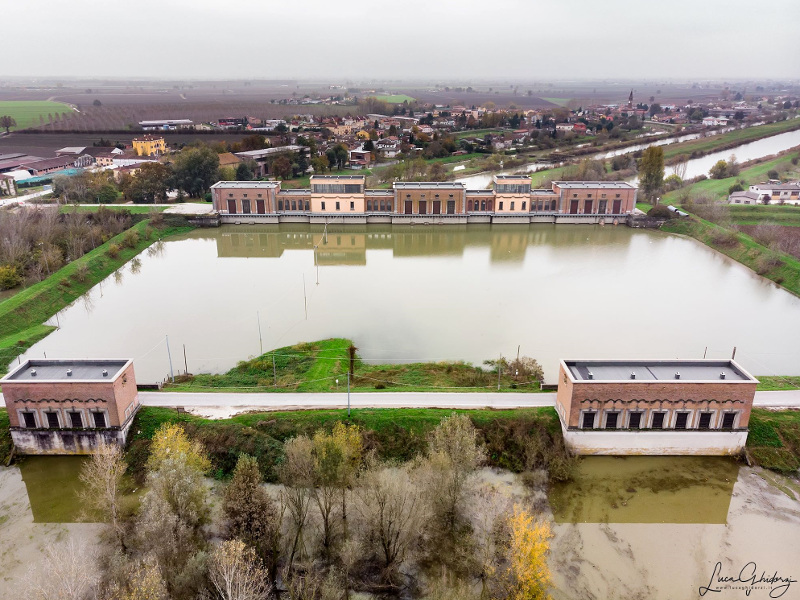
Canale Bogina is the final
stretch of Canale Navarolo: it leaves from the Municipality of
Commessaggio and ends in Oglio at the sluice gate situated in the
country hamlet Bocca Chiavica, after flowing for 6,039 m. It lies in
the most depressed area of the provinces of Mantova and Cremona, whose
water system management is entrusted to Navarolo land-reclamation
co-operative. The main remedies realized by the local population to
face the frequent and sometimes devastating floods of the rivers Po and
Oglio and their adjacent regions include the embankments of the two
rivers already since Etruscan times and the land reclamation carried
out over the centuries, which led to the canalization of the inner
waters. One of the main elements of this channel network is Canale
Bogina, dug again before 1498 to defend the area.
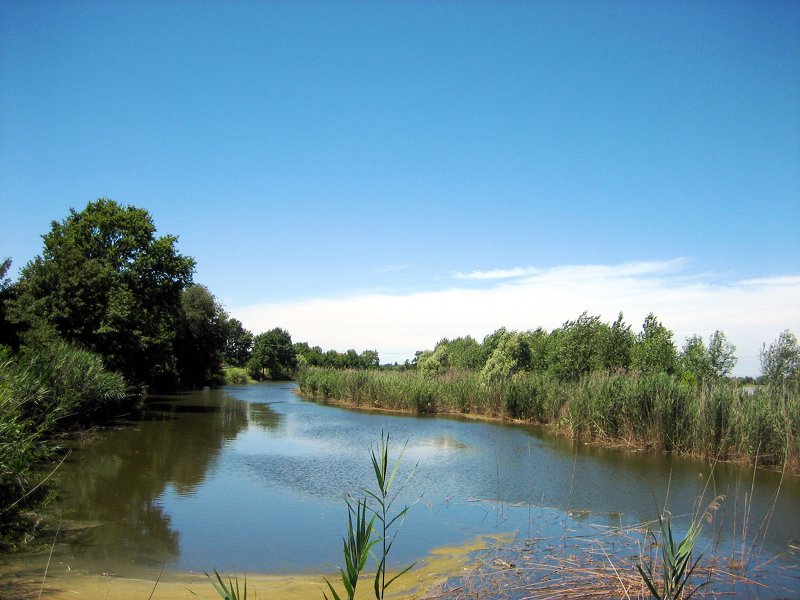
Vegetation and Flora
Canale
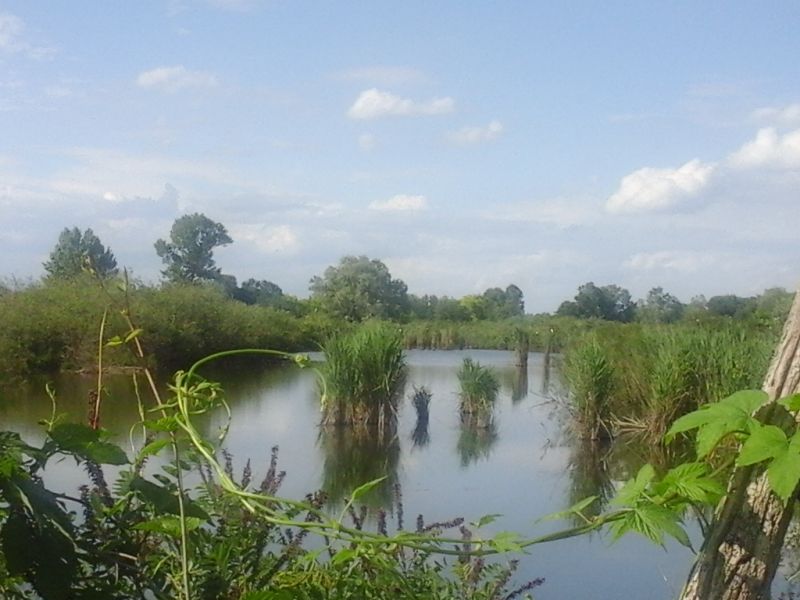
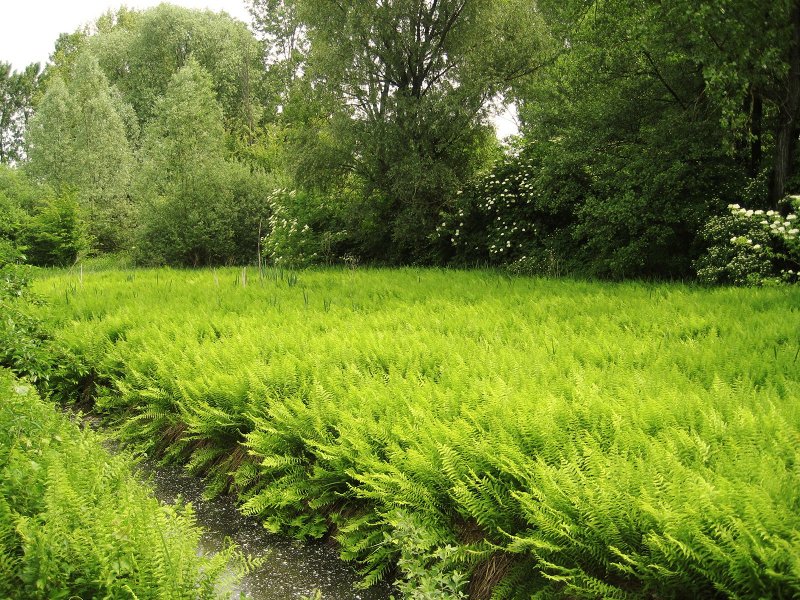
Bogina houses large stretches of riparian vegetation alternating to
ponds, places of particular value in the monotonous agricultural
landscape of the plain.
The series of unbroken natural areas - which
are not interrupted by cultivated fields or roads - has transformed
this canal into a real "ecological corridor", that is a group of
natural spaces connected among them and with the river offering
favorable conditions to the wildlife.
The lack of barriers between
the natural environments promotes the wildlife movements to other
areas: to find shelter, in case they are disturbed, and to find new
areas to search for food and reproduce.
Further info (Italian text)
Origins and Some History
The river Oglio flows towards
the river Po with a winding course, forming bends that may close and
give origin to inlets. Should they evolve naturally, they would
degenerate and the ancient river bed would entirely fill up with the
subsequent formation of fertile lands, very wet, ready to be exploited
by agriculture. Also in the case of Sant'Alberto, situated in the
Municipality of Marcaria (MN) on the left bank of the river Oglio, a
bend closed: as a consequence, the river bed straightened and a large
flood plain formed on the left bank of the river Oglio. This area is
interested by floods and is fairly fertile for agricultural purposes.
The
origins of Sant'Alberto estate are not clear, but it probably already
existed in the 17th century: it was not characterized by the presence
of houses, but only by wooden and straw blocks of buildings, lands
mainly dedicated to sheep pastures, and large woodlands used as hunting
reserves. The presence of ponds gradually grew from 1750 to 1960
because of the sand quarries excavations: afterwards, some of them have
been closed, while others have been characterized by renaturalization
with hygrophilous woods formations, already present at the beginning of
the 20th century and very important from a botanical point of view.
In the northern stretch of the flood plain, close to the main
embankment, it is still possible to see an ancient meander of the river
Oglio, a large and diversified wetland used in the past for fish
breeding. The land-reclamation system used for this oxbow is rather
interesting: it consists of digging large ditches by recovering
parallel strips of land forming, on both sides of the oxbow, a fishbone
structure. The area is characterized by the presence of some holes in
the ground filled with water, whose formation mainly depends on the
flood action when they meet an obstacle like an embankment.
Vegetation and Flora
Free waters are mainly dominated by Greater Duckweeds formations (Spirodela polyrhiza) and by a rich riparian vegetation dominated by sedges (Carex riparia and Carex acutiformis).
Of particular interest a small woodland whose forest phytocoenosis consists of an arboreal stratum dominated by Elm (Ulmus minor) which, because of its smaller size, has a subordinate position with respect to the Common Oak (Quercus robur) and the Raywood (Fraxinus oxycarpa).
Further info (Italian text)
Origins and Some History
Large area situated in the
west of the town of Belforte, in the Municipalities of Gazzuolo and
S.Martino dall'Argine, in the north of the drainage channel "Acque
Alte", it is delimited by an ancient meander of the river Oglio and has
been deeply shaped over the centuries by the peat extraction activity:
its use as a fuel dates back to the first half of the 20th century.
Today, after the land reclamation works carried out with the creation
of a thick network of drainage channels, almost the whole area is
designated to poplar cultivation, precious broadleaf trees, and crop
rotation. The two remaining natural nuclei are situated in the southern
stretch of the area and extend for about 18 hectares.
The relict
natural environments, of great natural value since they represent
landscapes and ecosystems of the peat bog depressions near the rivers,
give the whole valley a significant ecological value.
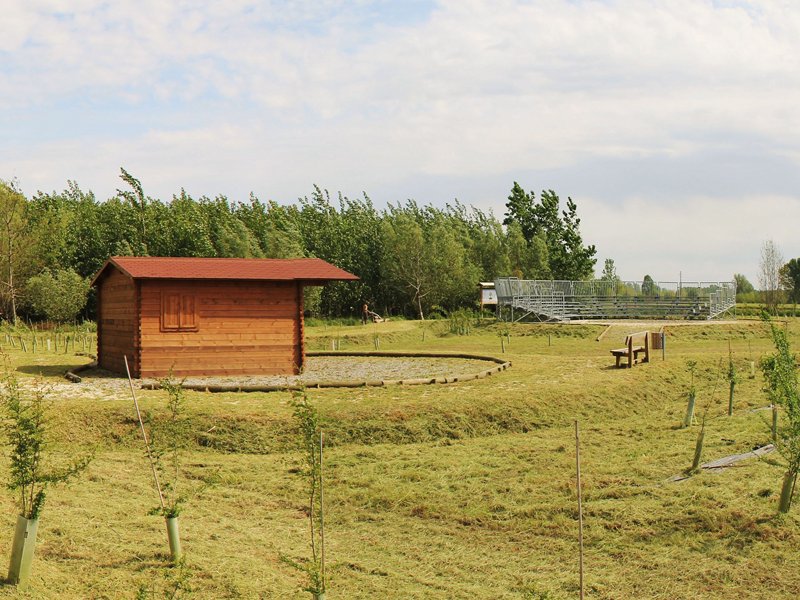
A
cycling-pedestrian route and an equipped picnic area called Le
Margonare, situated in the territory of San Martino dall'Argine near
some renaturalized quarries, favor the access and visit to the site.
Vegetation
The two nuclei characterized by
natural vegetation are dominated by wetland formations with a different
evolution degree; the drainage channels and the ponds with good-quality
hydrobiological features are covered by marshy herbs and floating
vegetation and are surrounded by arboreal and shrubby formations.
Further info (Italian text)
Some History
Marcaria Peat Bogs are situated in the
territory of the Municipality of Marcaria (MN) and represent one of the
last evidences of marshy environments - very widespread in the past -
along the river Oglio. Peat bogs and marshy areas like Marcaria
probably formed in the past a continuum along the river areas; today
they represent rare and fragmented environments both because of land
reclamation activities and river retention works. These relict areas
have been acknowledged all over the world for their high productivity
and biodiversity.
Marcaria Peat Bogs, Nature Reserve of Parco Oglio
Sud, SCI, SPA, 40 hectares of respect area, have been exploited since
the mid-19th century for the peat extraction. The presence of small
lake basins with irregular outlines derives from this activity, which
was one of the main activities characterizing the area between the
beginning of the 20th century and World War II. Most of the population
used to work in the quarries, organized in small family cooperatives or
employed by larger companies. In the early post-war period, the deposit
was almost worked out and in the last forty years the area has been
used to cultivate reeds, to practice hunting and fishing and, in its
marginal stretches, for poplar cultivations.
Origins of the Wetland
The
Reserve extends in an ancient meander of the river Oglio, in a basin
whose limit is represented by a steep slope connecting the valley with
the nearby elevated areas with altimetric differences reaching 4-5
meters. In the basin, naturally wet for the surface water layer
characterizing it, cane-brakes and other marshy formations have
developed. The soil asphyctic conditions have hindered the
decomposition of the vegetable deposits which have accumulated in 3 to 6
meter thick strata and which give the soils the characteristic color:
dark because of their richness in organic substance.
Vegetation
The Peat Bogs are mainly characterized by cane-brakes with close formations dominated by Common Reed (Phragmites communis), with occasional presence of Broadleaf Cattail (Typha latifolia) and small stretches of sedge formations consisting of various sedge species, among them the Purple Loosestrife (Lythrum salicaria), localized above all along the edges.
Further info (Italian text)
Origins of the Wetland
The river Oglio represented the
natural border between the provinces of Mantova and Cremona and in this
area, between Calvatone (CR) and Acquanegra sul Chiese (MN), it formed
a large meander. In 1790-91, the meander was straightened because of
the danger represented by the continuos landslides characterizing the
banks. The abandoned meander, called "Oglio morto", currently forms the
main area of the Nature Reserve covering 20,46 hectares and 76,30
hectares of respect area. The area delimited by the meander and the
river has been characterized over the centuries by various agricultural
cultivations, and at the moment by poplar cultivation. The name of the
Reserve and farmstead "Le Bine" derives from the word "bina" meaning in
Lombardy "shelter, pile-dwelling". Le Bine Reserve is both SCI and SPA.
Some History
During the last two centuries, the
soil formed by the ancient meander has been used as agricultural land,
except for Oglio morto, where - a rare relict by now - the wetland
survived: an area of great importance for the life of several vegetal
and animal species.
Vegetation and Flora
The Reserve houses several species belonging to the Red List: among them, there are common species like the Floating Watermoss (Salvinia natans) and the Marsh Seedbox (Ludwigia palustris), as well as species that disappeared about ten years ago, like the Water Caltrop (Trapa natans), the Water Violet (Hottonia palustris), and the Hawaii arrowhead (Sagittaria sagittifolia). In the water stretches the Floating Watermoss and the Common Hornwort (Ceratophyllum demersum) are rather common, although the latter has considerably reduced in the last years.
Further info (Italian text)
Origins of the Wetland
Gerra Gavazzi and Runate Oxbows
are situated on the left bank of the river Oglio, in the Municipality
of Canneto sull'Oglio (MN). They are a nature reserve, SCI, and SPA and
cover an area of 30,83 hectares.
The meanders have been isolated
from the river after a change carried out at the end of the 18th
century to promote navigation. The area was used for fishing.
Some History
The
history of Gerre Gavazzi marsh, named after its owner, begins in the
mid-18th century with a legacy forcing the owners to maintain the state
of the area, favoring the survival of the habitat until present times:
during the 70s, when the obligations and prohibitions set two centuries
before were no longer valid, the estate suffered from a considerable
environmental deterioration because of tree cutting, the total
abandonment of the marsh, the destruction of the resurgences, the
presence of a dumping ground.
The Park has engaged in the safeguard
of the Reserve to recover the natural conditions of the site through an
environmental revitalization project, with measures to open the oxbows,
plant hygrophilous woods, and create bumper areas, small observation
structures, and thematic routes.
Vegetation and Flora
The
oxbows are characterized by small stretches of water with very
different evolution degrees, since the aquatic environments of Runate
are big-size basins, while Gerre Gavazzi is characterized by an
advanced silting up because of the development of the willow grove
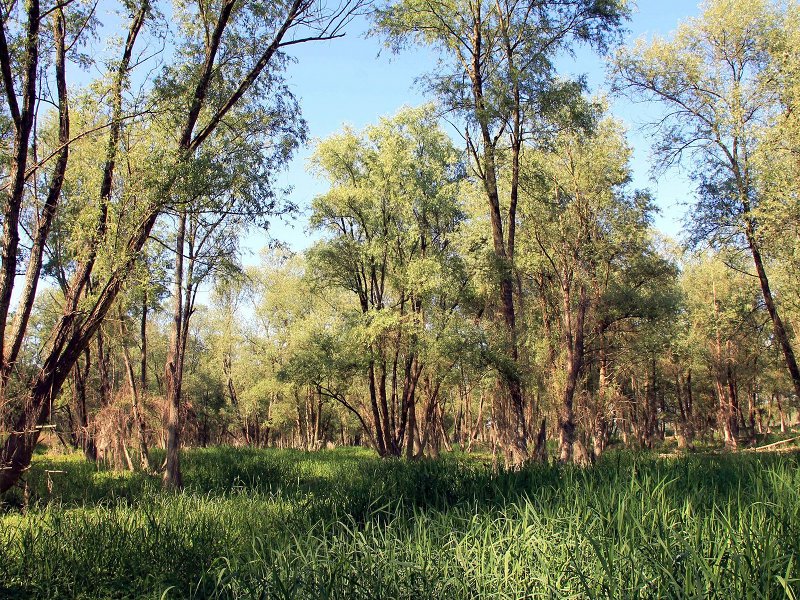
dominated by the Grey Sallow (Salix cinerea), which has almost completely covered its surface.
Further info (Italian text)